









A white embroidered shirt, a woven skirt, several rows of coral beads, and a flower wreath make up the familiar image of a Ukrainian woman in traditional clothing. It is a beautiful image, but it tells only part of the story.
The Ukrainian traditional dress women wear in museum collections and old family portraits was never one fixed national uniform. A woman’s clothing depended on her region, village, age, marital status, family resources, and the occasion. A festive outfit from Poltava could look very different from one found in Bukovyna, Polissia, Podillia, or the Carpathians. Ukrainian traditional dress also carries roots that go back further than any single village style, with ancient Slavic elements and, in some regions, traces of Byzantine influence woven into the patterns.
These garments were practical, decorative, and closely tied to community life. They could show where a woman came from, whether she was married, what textile traditions her family knew, and how much work had gone into preparing clothing for a wedding or religious holiday.
What Is Ukrainian Traditional Women’s Dress?
Traditional women’s clothing in Ukraine was usually built from several separate items rather than one complete dress.
The base was often a long linen or hemp shirt, prized for its durability. Over it, a woman might wear a woven waist garment, skirt, apron, sash, vest, or coat. Jewelry and headwear completed the outfit. The materials and cut changed with climate, local craft, wealth, and fashion.
A typical Ukrainian outfit might include:
- an embroidered shirt;
- a plakhta, zapaska, or woven skirt;
- one or more aprons;
- a wide woven sash;
- a sleeveless fitted garment;
- coral, glass, coin, or metal jewelry;
- a wreath, scarf, ochipok, or namitka;
- leather shoes, boots, or woven footwear.
The exact combination mattered. A flower wreath and ribbons did not carry the same social meaning as the covered hair of a married woman. A richly decorated wedding garment was not the same as the clothing worn for everyday work.
Men’s clothing followed a related logic, using much of the same linen and hemp fabric and echoing the shirt-and-sash structure worn by women, though cut and decoration differed.
The term traditional Ukrainian dress refers to a broad system of regional clothes, not one costume copied across the country.

Why There Is No Single Ukrainian National Costume
Ukraine covers a wide geographic area with forests, steppe, mountain communities, river regions, and long-established trade routes. Local clothing developed in response to these conditions, and each region shaped its own patterns, colors, and techniques.
The Encyclopedia of Ukraine groups folk dress into several broad regional traditions. In the Middle Dnipro area, women commonly wore wide-sleeved shirts, plakhty, fitted bodices, outer garments, and elaborate head coverings. In the forest-steppe belt, known as Lisostep, clothing often featured sleeveless fitted garments paired with closely tailored skirts. Polissian clothing preserved older forms, often combining embroidered shirts with colorful woven skirts and white namitky. Podillian outfits used distinctive woven wrap garments and dense embroidery, while parts of Galicia, Volhynia, Bukovyna, and the Carpathians had their own fabrics, jackets, head wraps, and decorative techniques, with Carpathian dresses in particular known for bold, colorful floral embroidery.
Even neighboring villages could develop different sleeve designs, colors, or ways of wrapping cloth around the body.
This variety is one reason the phrase Ukrainian national dress can be misleading. It works as shorthand for the tradition as a whole, but it shouldn’t erase the different regions that created it.
A museum-quality folk costume is usually identified by place and period: Poltava region, late nineteenth century; Hutsul area, early twentieth century; central Podillia, a particular district or village. Without that detail, a costume may look Ukrainian but tell little about its actual source.
The Vyshyvanka: More Than an Embroidered Shirt
The best-known part of Ukraine culture clothing is the handmade embroidered shirt, commonly called a vyshyvanka.
Traditionally, it was sewn from natural cloth such as linen or hemp and decorated by hand. Women’s shirts often carried their strongest embroidery on the upper sleeve below the shoulder, with narrower designs added to the collar, cuffs, front opening, or hem.
The embroidered shirt was never just a decorative blouse. Its fabric, cut, collar, sleeve, stitching, and pattern could point to a particular region, and the embroidery itself often signaled protection or social status as much as taste.
Ukrainian embroidery used many techniques. One of the oldest was nyz, a counted-thread method worked along the structure of the woven linen, alongside satin stitch and pattern darning, which were widespread long before cross-stitch became dominant in many areas. Cross-stitch grew in popularity partly because fashion magazines from the 1880s onward made it easier to reproduce trending designs at home.
This shift did not erase older methods, but it changed how embroidery looked. Geometric motifs are generally considered the most ancient type, while floral designs became especially visible later, particularly in western Ukrainian regions and the Carpathians.
Color meanings deserve some caution. Red is often the most prominent color across Ukrainian clothing, and red, black, and white together are strongly associated with Ukrainian embroidery; local traditions often attached protective, religious, emotional, or ceremonial ideas to them. Yet red did not always carry one meaning, and black was not always a sign of mourning. The interpretation depended on the region, pattern, period, and the object itself.
The safest way to read embroidery is as a visual language with local dialects, not a code where every symbol has one fixed national definition.
Plakhta, Zapaska, Skirts, and Layered Clothing
The full Ukrainian dress traditional ensemble was built in layers.
A plakhta was an old type of woven wrap skirt, usually made from wool and formed from panels of patterned cloth. Plakhty from the Kyiv, Chernihiv, and Poltava areas often used decorated squares and bold woven color combinations.
A zapaska was another wrapped waist garment. In some regions, women wore one panel in front and another behind. Elsewhere, a woven skirt, locally called spidnytsia, litnyk, andarak, horbatka, or another regional name, was more common.
Aprons were both practical and decorative. Some were made from linen or hemp; others were woven from wool and decorated with stripes or geometric designs.
A sash helped hold the clothing in place and finished the shape of the outfit. It could be narrow or wide, plain or brightly woven. In folk belief, the sash carried a protective role and was linked to fertility, since it encircled the middle of the body. One custom held that stepping over a red wedding sash could ease a future childbirth. Sashes also featured in wedding customs and family ritual more broadly.
Women might add a kersetka, keptar, kamizelka, or another sleeveless garment. In the Carpathians, sheepskin keptari were often richly decorated with leather, cord, embroidery, metal, or appliqué.
The clothing was beautiful, but display was never the only point. It had to hold up through cold winters, hot summers, church visits, travel, village celebrations, and ordinary labor.
Coral Beads, Coins, and Traditional Jewelry
Traditional women’s jewelry could carry as much weight as the shirt or skirt.
Rows of coral beads became one of the most recognizable elements of central Ukrainian dress. Coral was valuable, so the number and quality of strands could hint at family wealth. Glass beads, metal beads, coins, crosses, and pendants were also worn.
Some women combined several types of jewelry in one outfit. A necklace might mix coral, a metal religious object, and a row of coins. The result wasn’t random. The size, weight, order, and color helped balance the clothing and frame the face.
Jewelry could pass from mother to daughter and become part of family memory. A piece might appear at a wedding, show up in several generations of portraits, and outlast the shirt or skirt it was originally worn with.
That’s why old jewelry shouldn’t be described only as decoration. It could represent family property, religious identity, local taste, and continuity.
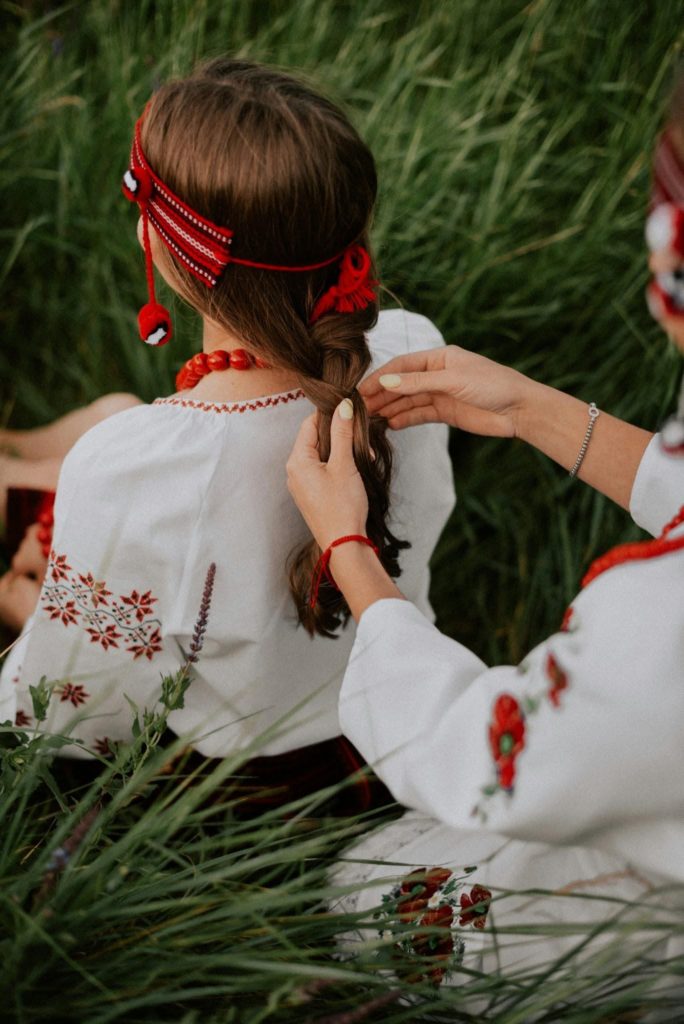
Wreaths, Ribbons, and Married Women’s Headwear
The flower wreath, or vinok, is now one of the most widespread images of Ukrainian femininity, and it has ancient roots — some sources trace it back to a pagan talisman meant to protect the wearer rather than simply decorate her.
Girls and unmarried women could wear uncovered hair, braids, ribbons, headbands, or wreaths, depending on place and occasion. Wreaths carried ceremonial and festive associations, and stylized versions later became common in stage costumes, photography, weddings, and national celebrations.
The large flower crowns seen today aren’t always exact copies of village headwear. Many are modern fashion pieces built on tradition rather than reconstructions of it.
Marriage changed how a woman covered her hair. An ochipok was a fitted cap that marked married status. A namitka was a long strip of cloth wrapped over the head, often covering the ochipok underneath it. Scarves and other local head coverings were used as well. The Ivan Honchar Museum collection includes ochipky, namitky, khustky, and vinky side by side, which shows just how varied women’s headwear could be.
Covered hair was never simply a fashion choice. It signaled that a woman was married and had entered a different social role.
How Clothing Identified Region, Age, and Social Status
Traditional clothing worked as a social signal.
The cut of a shirt might point to a region. A particular woven pattern could indicate a district or village. Headwear could show whether a woman was a girl, bride, married woman, or widow. Fine fabric, coral jewelry, detailed embroidery, and several outer layers might suggest greater family resources.
The condition of the garment mattered too. A carefully sewn festive shirt showed preparation and labor. A woman might keep practical clothes for daily work and save a more decorated outfit for church, weddings, or major celebrations.
No single garment told a complete story. Clothing didn’t reveal a woman’s personality or guarantee her beliefs. Still, it placed her within a visible network of family, community, age, and local tradition.
What Traditional Dress Says About Ukrainian Beauty
Traditional Ukrainian beauty was never based on one face, hair color, or body type.
The outfit built beauty through proportion, movement, color, texture, and care. Wide sleeves framed the upper body. A woven sash defined the middle. A skirt or plakhta added shape and rhythm. Jewelry brought color near the face, while headwear completed the portrait.
Beauty also depended on presentation. Clothing had to be washed, repaired, folded, wrapped, and put on correctly. Embroidery had to fit the cut of the garment. Jewelry had to work with the collar. A head covering took real skill to arrange.
A woman wasn’t beautiful because the costume made her look like everyone else. She was beautiful within a shared visual tradition that still made room for variety.
That distinction matters. Ukrainian culture shouldn’t be reduced to images of a young girl with long hair, a narrow waist, and red flowers. Older women, mothers, married women, widows, and working women all belonged to the clothing tradition just as much.
Craftsmanship, Family, and Women’s Cultural Role
Traditional clothing demanded real knowledge.
Someone had to grow or obtain flax and hemp, prepare thread, weave cloth, cut the shirt, sew the seams, work the embroidery, and finish the edges. Wool had to be spun and woven. Decorative items had to be bought, inherited, or made by hand.
Women were often at the center of this work. Skills moved through families and villages, passed from mother to daughter or shared between relatives and neighbors.
That doesn’t mean every woman made every item herself. Families had different resources, and specialized makers existed too. But women’s work played a major role in keeping regional textile knowledge alive.
The finished clothing carried more than individual taste. It held hours of labor and the memory of how a family made things by hand.
Regional Differences Across Ukraine
Poltava is often linked with refined embroidery, including restrained palettes and white-on-white work. Central Ukrainian costumes frequently paired embroidered white shirts with plakhty, fitted sleeveless garments, red accents, and layered necklaces.
Polissian dress preserved old cuts and woven forms. Red embroidery stood out in many areas, while long white head coverings and colorful skirts created a distinctive silhouette. Traditional footwear here could include lychaky, woven bast shoes.
Podillian embroidery was often dense and visually strong, with dark thread, geometric structure, and richly worked sleeves showing up across several local traditions.
In the Carpathians, clothing tended to be more layered and colorful. Hutsul outfits might include woven zapasky, decorated sheepskin keptari, metal ornaments, and postoly, leather footwear tied around the foot. Floral embroidery was common across several western areas, though it shouldn’t be treated as the only regional style there.
Boots known as choboty were popular throughout Ukraine, worn in many regions regardless of local costume style. Dress footwear called cherevyky became more visible in the nineteenth century as materials, trade, and urban fashion started reaching village clothing.
These are broad patterns, not fixed rules. The most accurate descriptions name a precise area, date, and source.
Common Myths About Ukrainian Women’s Clothing
One myth is that every Ukrainian woman wore a red-and-black embroidered shirt. In fact, colors varied widely, and some regions favored white thread, blue, yellow, green, brown, or multicolored designs.
Another myth is that every pattern had one exact meaning. Many symbols shifted across regions and generations, and modern interpretations are sometimes more definite than the historical record actually supports.
The flower wreath is also misunderstood. It wasn’t universal everyday headwear for every woman. Its meaning depended on age, marital status, place, and ceremony.
Traditional clothing wasn’t one long embroidered dress either. A historical outfit was usually built from shirts, skirts, wrapped cloth, aprons, vests, sashes, jewelry, and headwear, layered together.
It’s also a mistake to treat Ukrainian clothing as interchangeable with a generic “Slavic” costume. Ukrainian, Polish, Romanian, Belarusian, Russian, Slovak, Hungarian, and other neighboring traditions influenced each other over centuries, but they were never identical.
How Ukrainian Women Wear Traditional Style Today
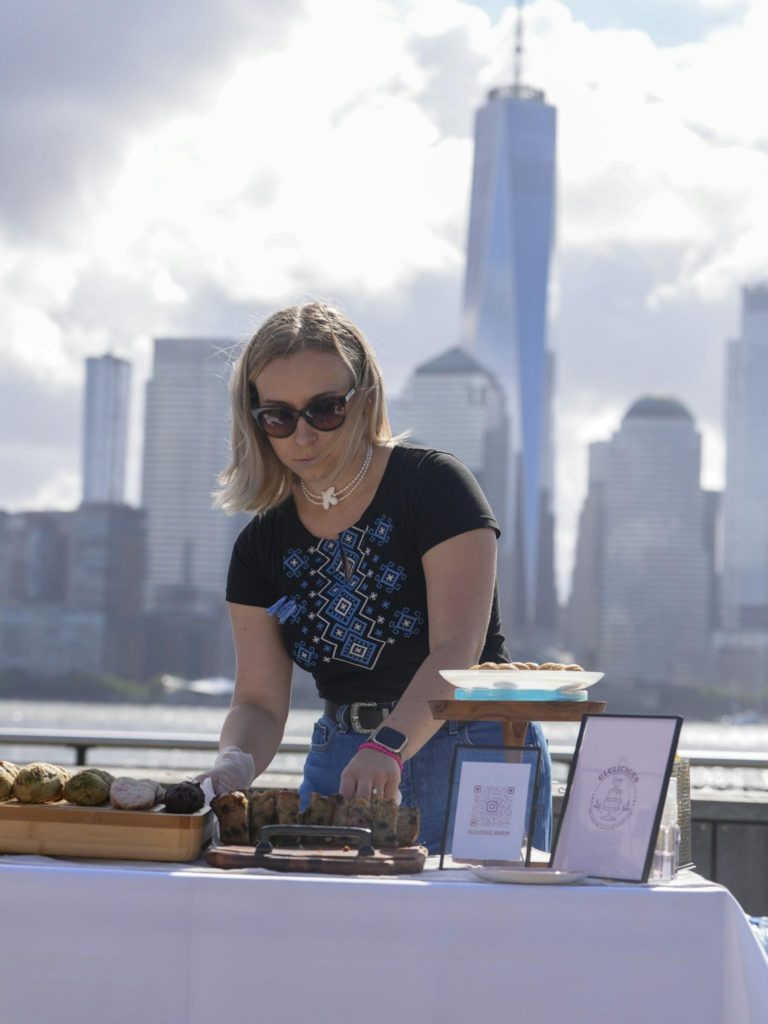
Most Ukrainian women don’t wear a complete folk costume day to day. They may, though, wear a modern embroidered shirt or dress with jeans, trousers, a skirt, or a jacket.
Contemporary Ukrainian designers work traditional sleeves, woven cloth, embroidery, floral patterns, and regional references into modern fashion. Some pieces closely follow museum examples. Others reinterpret the source freely.
That distinction matters. A historical reconstruction tries to reproduce a garment from a particular place and time. A contemporary vyshyvanka may draw on tradition without copying an old shirt exactly.
Women wear embroidered clothing at weddings, family celebrations, cultural events, national holidays, diplomatic occasions, and ordinary gatherings. Its popularity has made it both formal wear and something deeply personal.
Vyshyvanka as a Symbol of Identity and Resilience
The vyshyvanka is now one of the clearest visual symbols of Ukraine.
It represents family history and regional craft, but it has also become tied to political freedom, cultural survival, and resistance to attempts to erase Ukrainian identity. Ukrainians wear it at home, in the military, in schools, at public events, and across diaspora communities. European heritage sources describe it as a symbol of belonging, unity, and resilience as much as a form of clothing.
Vyshyvanka Day started as a student initiative in Chernivtsi in 2006 and grew into an international annual celebration of cultural pride, held on the third Thursday of May. People wear embroidered shirts at work, school, or in public to show that the garment belongs to living culture, not only to museum cases.
Since Russia’s full-scale invasion, embroidered clothing has taken on even more emotional weight. For many people, putting it on has become an act of memory and solidarity.
How to Appreciate Ukrainian Dress Respectfully
Start by learning where a garment actually comes from.
Ask whether it’s a historical piece, a reconstruction, a modern vyshyvanka, or fashion inspired by Ukrainian embroidery. Look for the region, maker, material, and technique behind it.
Avoid presenting every flower, star, diamond, or color as a universal ancient symbol. Don’t call a generic costume authentic simply because it has red embroidery and ribbons.
Support Ukrainian museums, researchers, craftspeople, and designers. When buying clothing, check whether the seller names the source of the design and credits Ukrainian tradition.
Most importantly, don’t use traditional dress to build stereotypes about Ukrainian women. A woman wearing a vyshyvanka isn’t automatically submissive, rural, conservative, religious, or looking for a traditional marriage. The garment might express family memory, fashion, regional pride, national identity, or simple personal taste.
Ukrainian culture is best understood through real people, not romantic images. Register on the site, browse women’s profiles, and start a respectful conversation with Ukrainian women about their lives, traditions, and relationship goals.
Final Thoughts
The traditional clothes in Ukraine tell a story of variety.
No single shirt, skirt, color combination, or flower wreath represents every region. Ukrainian women’s clothing developed through local materials, family skills, village traditions, outside influences, and shifting ideas of beauty.
The embroidered shirt remains the best-known garment, but it belongs to a larger outfit built from woven cloth, aprons, belts, jewelry, outerwear, shoes, and carefully chosen head coverings.
Traditional dress expressed identity without making every woman identical. It showed how beauty could be tied to craftsmanship, family memory, dignity, and place.
Today, the same clothing keeps changing. It shows up in museums, family wardrobes, wedding portraits, street fashion, public demonstrations, and cities far beyond Ukraine. The form may be old, but its meaning is still very much alive.
FAQ
What is traditional Ukrainian women’s clothing called?
There’s no single name for the complete outfit. It may be called Ukrainian folk dress or a regional folk costume. Individual items include the vyshyvanka, plakhta, zapaska, kersetka, ochipok, namitka, and vinok.
What is a vyshyvanka?
A vyshyvanka is a Ukrainian embroidered shirt, traditionally sewn by hand from natural fabric such as linen or hemp. Its cut, stitching, colors, and patterns vary by region.
Did every Ukrainian woman wear a flower wreath?
No. Wreaths were mainly associated with girls, unmarried women, weddings, rituals, and festive occasions. Married women traditionally covered their hair with caps, scarves, namitky, or other regional headwear.
What is a plakhta?
A plakhta is a woven woolen wrap garment worn around the lower body. It was especially common in parts of central and northern Ukraine and often featured checked or geometric patterns.
What did married Ukrainian women wear on their heads?
Married women commonly covered their hair. Depending on the region, they might wear an ochipok, namitka, scarf, cap, or a layered combination of these items.
What colors are common in Ukrainian embroidery?
Red, black, and white are the most widely recognized, but Ukrainian embroidery also uses blue, green, yellow, brown, and other colors. Regional traditions differ significantly.
Does every embroidery symbol have a specific meaning?
No. Some motifs carried protective, religious, family, or ceremonial associations, but meanings varied by place and period. Many popular modern interpretations are more general than historically accurate.
What shoes were worn with Ukrainian traditional dress?
Footwear included woven lychaky in Polissia, leather postoly in Carpathian areas, choboty boots across many regions, and dress shoes or boots known as cherevyky.
Do Ukrainian women still wear traditional clothing?
Complete folk costumes are usually worn for performances, reconstructions, weddings, or cultural events. Modern embroidered shirts and dresses are widely worn for holidays, work, celebrations, and everyday fashion.
When is Vyshyvanka Day?
Vyshyvanka Day is celebrated annually on the third Thursday of May. Ukrainians and supporters of Ukraine wear embroidered clothing to express cultural identity and unity.